TSXV: LVX $0.49

About Leviathan’s greater KCB landholding

At Leviathan’s Ngami NE Project, a 12-to-14-kilometer strike length of the DKF-NPF contact has been interpreted from magnetic data below the Kalahari overburden, within a window free from basalt cover. Cobre Limited have reported several thick Cu-Ag mineralized drillhole intersections from their Ngami Copper Project (NCP) 15 to 30 kilometers to the southwest along strike from the Ngami NE Project on the DKF-NPF contact, potentially on the same magnetic feature.

Several of the better holes drilled by Cobre include 10.7m at 1.3 % Cu and 18 g/t Ag from 136.2m in hole NCP08, 14.9m at 0.5 % Cu and 13 g/t Ag from 142.5m in hole NCP42, 9.6m at 0.6 % Cu and 9 g/t Ag from 263m in hole NCP38, and 26.0m at 0.4 % Cu + 1 g/t Ag from 272m in hole NCP404.

Leviathan's Maun Project is approximately 90 - 100 km on strike NE from MMG’s 'Zone 5 Corridor.' The Maun Project 'straddles' almost the full width of the KCB, and as such, there is a high likelihood that the DKF-NPF is present and that multiple anticlines and synclines are repeating the stratigraphy and potentially favourable structural sites. However, the Maun Project is entirely covered by an unknown thickness of Karoo basalts and dolerites in addition to the Kalahari cover.
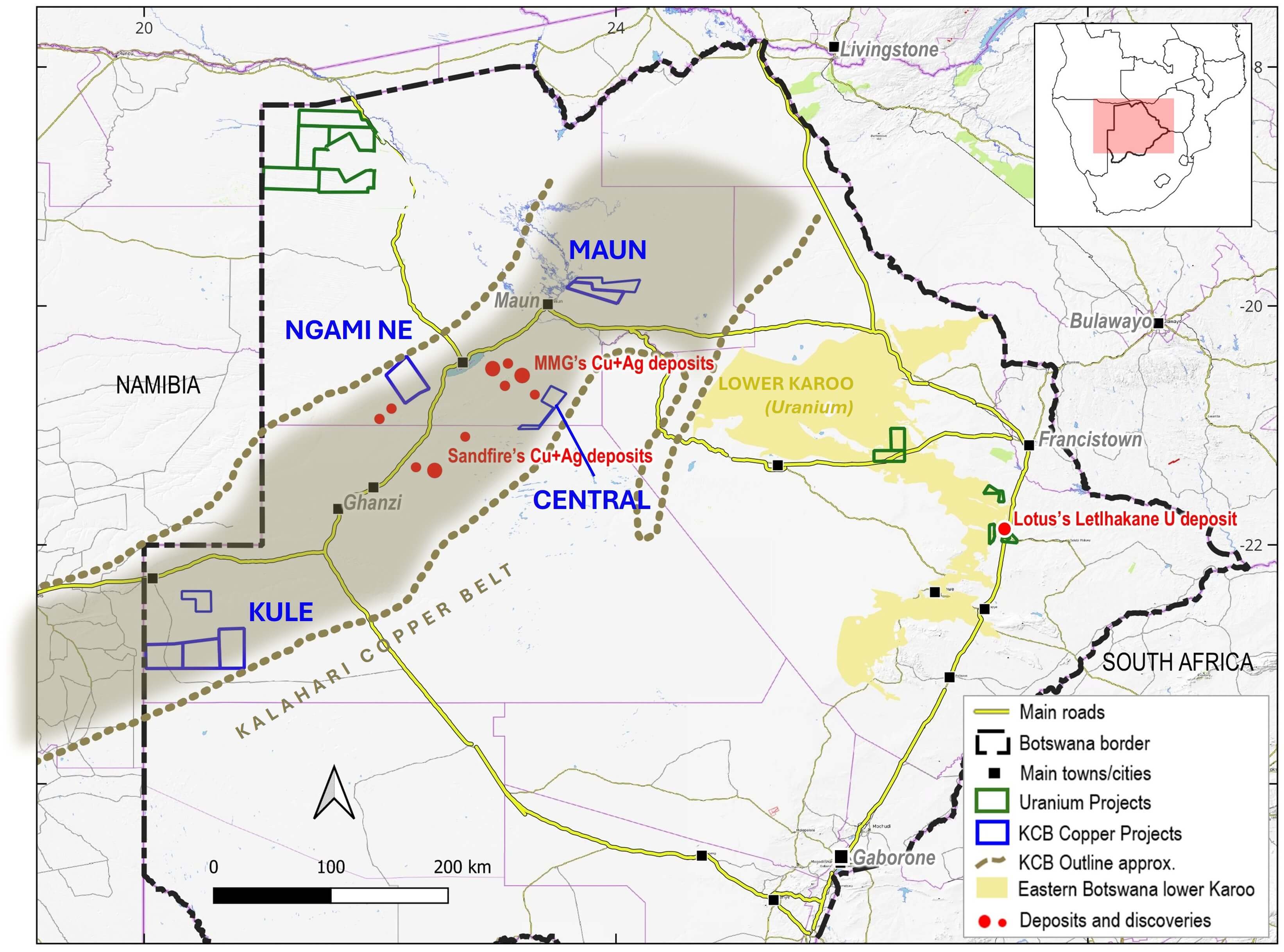
4 https://api.investi.com.au/api/announcements/cbe/be45e31e-52d.pdf and others

However, the Maun Project is entirely covered by an unknown thickness of Karoo basalts and dolerites in addition to the Kalahari cover.

Kalahari Copper Belt

The 800-kilometer-long Kalahari Copper Belt hosts significant Cu-Ag deposits of the Sediment-Hosted Stratiform Copper type, and is regarded by the USGS “as one of the world’s most prospective areas for yet-to-be-discovered sediment-hosted copper deposits”.

Most KCB discoveries have been made within the last 25 years, and the largest deposits within the last 15 years. The KCB’s proven Cu-Ag potential, coupled with simple, reliable and transparent regulation, ready infrastructure, and a skilled workforce make it a makes it a highly attractive region for exploration.

Much of the KCB is covered by young overburden of the Kalahari Group sands, which conceals the target geological structures and formations. Using modern geophysical and geochemical methods, new copper deposits may be identified within this highly underexplored district, and it is for this reason that most KCB deposits have been found relatively recently.

Most known KCB Cu-Ag deposits are located at or near a well-understood stratigraphic boundary, specifically that between Ngwako Pan Formation and the overlying D’Kar Formation, or more simply the “DKF-NPF contact”, itself a so-called “redox” boundary. Deposits form in favourable structural sites such as fold hinges, parasitic folds, shears and thrusts, considered important in channeling and constraining fluid flow, and in trapping the fluids. Copper mineralization is present in sulphide forms, including chalcopyrite, bornite and chalcocite, and can attain thicknesses of tens of meters, extending hundreds of meters along strike and dip.

As their name implies, Sediment-Hosted Stratiform Copper deposits are hosted by sedimentary formations, and these generally exhibit lateral continuity even if folded. In the case of the KCB, these host formations display distinctive magnetic and electromagnetic (EM) signatures, and as such magnetic and EM surveys are of importance in interpreting “DKF-NPF contact” and the folds, shears and hinges that may affect it, to define drill targets.

Join
Our Mailing List Today!